Showing posts with label Karnataka. Show all posts

Sunday, March 09, 2008

What is so local about it!!!

A lot has been said and written about this issue. It has been a while since I though I should put down my opinion on it.

Now the question – should locals be given preference in their native states for jobs. My answer both YES and NO.

Broadly I would like to divide the jobs into two sections. The first section – the professionals – IT, banking, management, consultants, etc, basically people with a professional degree. The second section – what you call the blue collar jobs, which includes manufacturing, construction, sales people in malls, security staff, house keeping staff, etc.

People who qualify for the first section of jobs are well educated and also the jobs in this section are very demanding. Competition should be the order of the day for these jobs. For this category there should absolutely be no preference given to the any category of people. As David Sarnoff (the founder of NBC) said “Competition brings out the best in products and the worst in people”. Only the fittest should survive. There should be no discrimination here.

The second section is the mass jobs sections. It is absolutely necessary to have some sort of reservation for the locals here. Taking a broader view – not doing this will lead to many social problems (Did someone mention about naxalism spreading rapidly in South India?). The jobs in this section do not require high degree of skills and even if they do need, it can be met with some basic training. The people who qualify for this section generally belong to the lower class of the society as CK Prahalad puts it – people from the “bottom of the pyramid”. They are the people who form the majority of any society. The welfare of these people should be the main concern of any government (obviously they also form the biggest vote bank).

Certain state governments have done better than others in attracting investments into their state. They have worked harder at providing facilities to companies than other states. They have acquired lands from people in their state to give it to these companies, in the hope that these companies generate large employment opportunities. They have provided water and electricity at subsidized rates (as a result the whole state pays extra to offset this) to these companies. They have invested large portion of the state revenues to develop infrastructure (though they are not sufficient). Having been part of all the sacrifices what is wrong when people from these progressive state demand some preference in jobs. These people should have the first right to the fruit of success of their states.

Why should the people of these progressive states pay for the mistakes of the governments of these non progressive states? Sprit of nationhood should exist but that not at the cost of the well fare of the local population. I am surprised to see the politicians from these non progressive states reading out rules from the constitution regarding equality (Opps I am just wondering if they ever had opened this book ever before!!!). Had they followed this very constitution properly in their states, their people would not have come to other states in search of livelihood. These politicians should get their priorities right before they do anything else. Rather than shouting their hearts out, they should look at emulating the progress of other states in their own states.

Is it a coincidence that a larger percentage of Biharis are getting the railway jobs? Is it a coincidence that more and more trains are being introduced to Bihar (from all over the country)? Bullshit – shamelessly they talk of the spirit of nationhood.

Having said all this, do I approve of the kind of tactics that Raj Thakre employ? – NO.

It was sad to see, the extents to which people go to promote ones own political ambitions. These people are more interesting in publicity rather than the welfare of their own people.

If regional parties like our very own KRV are really concerned about the local population then they should –

  • Lobby with the governments to open more ITIs (industrial training institutes). These are the institutes that impart training to people for manufacturing, construction, etc. They do wonders to the economy of any state. Provide a larger pool of skilled workers. This will attract more companies. It’s a vicious circle.
  • Stop opposing English as a medium of instruction. Kannada or the local language should be made compulsory, but there is no point in opposing English. It is this language that will finally decide if someone gets a job or not.
  • Open more finishing schools. These schools (similar to the ITIs) provide essential industry specific skills for people who wish to join the retails industry, call center jobs, etc. IIIT Bangalore opened recently opened one such school to help local IT graduates.
  • Lobby with the government to see to that companies that handle large infrastructure projects in the state hire people locally rather than people from outside. I have seen a few infrastructure companies from AP getting people from AP to do jobs here. For all government jobs, the companies should be forced to use local labors.
  • Instead of targeting IT companies for reservation in IT jobs, they should focus their energies on large retail and construction companies, house keeping companies, textile companies to hire local people.

But taking up these issues wont provide the regional parties with instant publicity and fame that they want, they wont get the TV coverage like what they get when they attack IT companies or outside people.

Mr Narayana Gowdare its time to rethink your game plans, having a non violent stance will legitimize your demands and also help you win over more people. You cause seams to be good, but the way you want to achieve it does not.
Tuesday, January 15, 2008

Badami

Badami was the 2nd capital of the Chalukyas and is around 50km from Aihole. Also know as Vatapi (named after the demon of the Ramayana epic) it is located at the mouth of a ravine between two rocky hills and surrounds Agastya tirtha water reservoir on the three other sides. The town is pretty well developed with numerous hotels and lodges. If you are planning to visit Aihole, Badami and Pattadakallu, you can make this place as the base.

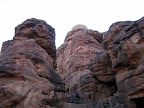
The place gets its name from the color of the rocks in the region. They are similar the color of the dry fruit – Badami and hence the name.


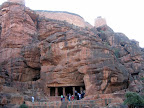
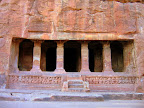
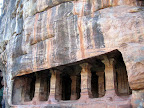
Badami has a number of temples built between the 5th and 8th century, the most famous among them are the cave temples. Due to time constraints and the fatigue of having traveled to Hampi, we decided only to visit these cave temples. There are 4 cave temples (plus one natural cave).

Chalukyas were predominantly followers of Lord Vishnu, however the latter kings were also followers of Lord Shiva. A few also embraced Jainism. This is evident from the 4 cave temples. The first one is dedicated to Lord Shiva, 2nd and 3rd dedicated to Lord Vishnu and the 4th one to Jainism. In the 5th (natural cave) there is a sculpture, though the exact identity of this carving is not know, it is though to resemble Lord Buddha.

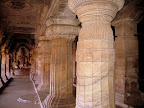
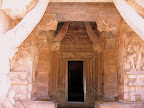
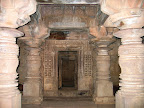
The temples have been carved into the hills, except for the deities nothing in the temples is foreign. Everything has been carved into the finely grained horizontally stratified sandstone hills of Badami. Each of these temples are characterized by a pillared “mukha mutapa” (verandha), then a “maha mantapa” and then a small cell – the “garbha gudi” which houses the God.

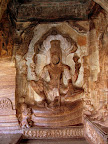
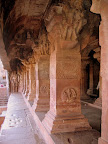
The 3rd cave (from below) dedicated to Lord Vishnu is the oldest among the 4 caves. It is also the most grandest and the biggest of all the 4 caves. The main idol is missing (same is the case with the other Vishnu cave temple) – it is believed to have been destroyed in the 16th century during the muslim invasion. The sculptures and carvings here depict the various incarnations of Lord Vishnu including Bali Chakravarthi, Vijayanarasimha, Ranganatha among others.


According the inscriptions found, the 3rd cave was completed in 578 AD. The pillar brackets are finely decorated with male and female figures - with fertility being the main theme.


The 6th century paintings on the ceiling of these caves are still visible. The guide told us the main inspiration of these cave temples for the Chalukyas were the Anjantha caves.

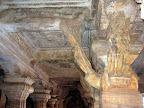
The pillars of this cave temple like all vishnu temples are highly decorated.


The 2nd cave (from below) is the 2nd oldest temple and is also dedicated to Lord Vishnu. It is much smaller than the 3rd cave. However it is very much similar to it.

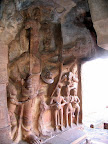
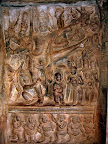
Again this temple consists of various incarnations of Lord Vishnu. The most brilliant carving here is that of Bali Chakravathi (right side picture below). A similar carving is also present in the 3rd cave and it is believed that both these carvings are a replica of carving found in the Durga temple in Aihole.

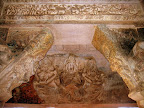
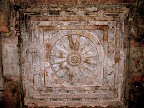
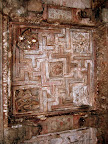
The sculptures on the ceiling in this temple is amazing. Most of the patterns and designs here are replicas of the ones found in the Aihole temples. If you observe the picture below (right side) closely, it can represent a fish wheel (Meena Chakra) or a lotus flower. The 2nd image is that of the scared Swasthik.


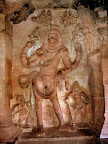
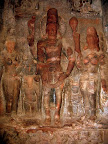
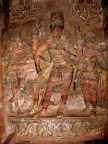
The 1st cave is dedicated to lord Shiva. It is smaller than the 3rd cave but bigger than the 2nd cave. The Shiva Linga is still present but it has been partly damaged. This cave consists of carvings of Shiva, Ganesha, Parvathi and Subramanya. Two very interesting carvings here are that of HariHara (a single carving with one half representing Lord Vishnu and the other half represently Lord Shiva) and that of Shiva Parvathi (again one half of the carving is that of Lord Shiva and the other half that of his wife Goddess Parvathi)

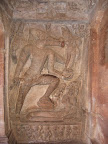
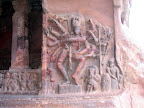
But the most fascinating carving of all is that of Nataraja. This carving depicts Nataraja with 18 hands, and depending on which two hands you consider, you can see a total of 81 dancing positions.


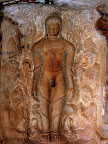
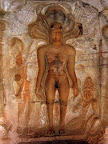
The 4th cave is dedicated to Jainism and consists of various Jain thirthankaras. Though not as big or as elaborate as the other 3 Hindu temples, the sculptures are very unique.

The carving of Lord Gomataeshwara is very similar to the statue found in Shravanabelagola.


Depending on your interests it could take 2-3 hours to view these cave temples. There are other temples in the vicinity, which we skipped. To cover all of them it could take a couple of hours more. The film Guru was also shot in this area.

Close to Badami there is Banashankari Temple and Mahakuta temples. Unless you are deeply religious you may want to skip Banashankari Temple, but the Mahakuta temple complex is worth a visit. Both these places are with in 20km from Badami. Mahakuta was also one of the capitals of the Chalukyas. There are lot of Shiva temples in this complex.


More pictures below:


Monday, January 07, 2008

Aihole

Aihole, it is often called the cradle of “Hindu rock architecture”. This ancient town was once the capital of the early Chalukyan Empire (the capital was latter shifted to Badmi).
Situated on the banks of the holy river Malaprabha (one of the 3 rivers that join at Kudalasangama) this town has more than 125 temples – with no two temples similar to each other. Infact many of the other architecture marvels of Karnataka including the ones at Badami, Pattadakalu, Belur, Halebidu, Somnathpura are based on the temples found in this place.

There is an interesting legend behind the name “Aihole”. Parshurama (the 6th avatara of Lord Rama) after one of his battles, washes his axe in the river Malaprabha, the blood on his axe turns the entire river into red. A lady who happens to be at the river at this instance, is shocked and starts shouting “aiyoo nana hole” (roughly translates to: Oh my river). Hence this place came to be known as “Aihole”. (This was what my guide told me.)

Inscription found there, indicate that during the 7th century this place also used to be a university for stone architecture. Much like modern day universities, this university used to grant “scholarships” to its students. This practice has been documented in one of the 7th century inscriptions found in one of the temples in Aihole. As a pre-requisite to successfully graduate from there the students had to construct a temple – this explains the vast no of temple in this area. This was the early phase of temple architecture in South India. It was the time when rules were yet to be defined. Each temple was an experiment; none of them are even remotely similar to each other.

This place is the foundation stone of the Dravidian and Jaina temple culture. The earliest temples were built here in the 5th century. The “Meguthi” temple here is the oldest dated structural temple in India, it was completed in 634 A.D. The inscriptions at this temple also take of the legendary poet and dramatist Kalidasa.

Aihole is the oldest of the 3 Chalukyan places – Aihole, Badami and Patadakallu. The temples here are spread over a vast region, and only a few are protected. It would take a few days to cover most of this rocky area. I spent less than an hour here and covered only 5 temples.


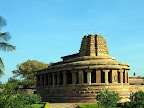
The external architecture of the Indian Parliament was based on the Durga temple. One look at this temple and the first thing that comes to your mind is the Parliament building. This not a temple dedicated to Goddess Durga as the name suggests. The temple is close to the fort and another name for the fort in kannada is durga or durgi and hence it got its name as Durga temple. It is a temple dedicated to Lord Vishnu (early Chalukyans were followers of Lord Vishnu – hence the majority of the temples here are dedicated to Lord Vishnu).

The main tourist place in Aihole is the Durga temple complex. There are around 4 temples with in this fort. And there is another temple (Ambigera Temple Complex) just on the other side of the road.

The sculptures here are very intrinsic and some are very exotic. The sculptures give a deep insight into the social life of the people. Every minute detail from the jewelry to the fashionable dress they wore has been documented in these sculptures. From the sculptures you could guess that short (and even mini) skirts were very popular at that time. Also special attention has been given to the sexual life of the people at that time. Episodes from Ramayana and Mahabharata have also been given great importance in the carvings here.
Unfortunately my camera batteries were drained out and I could take only a few pictures of this wonderful place. There is a KSTDC hotel near by; the food at this place is pretty good. They also have rooms to stay, but the facilities are very basic – there is no power during the day.

Friday, November 30, 2007

Mockery of Democracy

A common phrase that people so proudly use when talking about India society is “The world’s largest democracy”. Yes, we do have elections, we select are representatives. But are we really a functioning democracy?

“Democracy”

1 a form of government in which the people have a voice in the exercise of power, typically through elected representatives. 2 a state governed in such a way. 3 control of a group by the majority of its members.

This is the oxford definition of the word of Greek origin. Of the three definitions, in the Indian context, only the 3rd one makes some sense. Fine, we do elect our representatives, but do these representatives actually represent our voice? NO. I have a lot of issues concerning the type of democracy that we have in our country. But my concern for now is about the representation of voice.

Elections are around the corner in this part of the country (hmm.. who knows we could also have general elections soon). This is the time when political parties start making promises, and release manifestos. For most public, these promises and manifestoes form a significant factor that help them to decide whom to vote for. Obviously there are many other issues – caste, money, liquor, etc., that could have even more effect on certain sections of the society. When I say most public, I mean to refer to citizens for who development issues rather than other issues form the basis while selecting their representatives.

In most cases the public’s voice is what, which forms the part of the political promises and manifestos. Like poverty eradication, electricity, education, social security, infrastructure, etc. The parties promise many things in their public meetings and manifestos, depending on which people decide which party to vote for. But once these parties are in power, do they care to implement these promises? Forget implementing these promises, many times the governments do exactly the opposite.

Don’t we need a proper mechanism where political parties are penalized if their election promises are not implemented? Not implementing these policies certainly amounts to cheating the society. Is this not a criminal offense? A party wining an election and not honoring its promises is a breach of mutual agreement between the representatives and the society. There cannot be a greater crime that this in a democracy. There is an urgent need for some regulatory mechanism to over see this; this will not only deter the political parties from making false and opportunistic promises and duping the public.

Nandigram – this is the reason I am writing this. I would be surprised if any of the pro capitalist governments would even think of trying to do something that the communists did there. They did the exact opposite of what they were preaching for the last 30 years there. All of a sudden they woke up to development and decided that they had to give land to capitalists.

Karnataka – how can I forget this? As long as they had power it didn’t matter to them about any of the promises to the public. All they wanted was power. It was the dirtiest dance of democracy anybody could have witnessed. How a hand full of people played their games with the hopes of 50 million people of this state. Bond papers and ministries were more important to them, than the interest of the general public.

What ever democracy that we have at present is the worst form of democracy. People are displaced from the ancestral lands without proper compensations, women are striped and beaten brutally because someone does not like what she asks for, another lady is made to run from city to city because someone did like what she writes, natural resources are illegally mined and exported to other countries, the list goes on and on….

Do we have any hope? The only thing that can force a government to do its job rightfully is the civil society. But how strong is this society whose stake holders are me, you and every citizen? We are more concerned about our self well being, than about the collective good.

Do we have a solution? Is our system the worst form of democracy?

Sunday, November 18, 2007

Krishi Mela - 2007


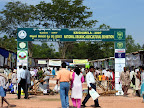
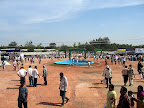
Krishi Mela, is an annual farmer fest organized at the sprawling 1400 acer GKVK campus on Bellary road. It is organized by GKVK itself. They showcase all the latest developments in agriculture field in this 4 day mela. Buses to his mela is arranged by the government from all over the state.


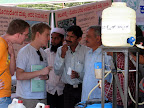
The students and faculty of GKVK did an excellent job explaining the new technologies to all the visitors. Expecting this fair to be like most dull government events, i was in for a pleasant surprise. The students at the stall were very warm and outreaching to everyone. I was happy to see them explain everything to the farmers with same intensity with which they talked to well dressed city people.

There were also private companies exhibiting their latest agriculture products - machinery, seeds, pesticides, etc. This years mela had special focus to organic farming. Looking at the numbers farmers who attended the mela, it was big success. They are expecting close to 200 thousand people to visit this year.


There are (i think) 7 agriculture colleges spread through out the state. Very few young people have the knowledge of these colleges or about the graduate programs they offer. With the advent of organized retailing (read contract farming) in this country, career opportunities are bound to grow for graduates of these colleges.




For a country like India to prosper, the real growth should come from the agriculture sector. Depending on the monsoons, the growth in this sector has been a dismal 2-4% (sometimes even -ve growth). The 9% growth in GDP that we have now is mainly because of the services sector (the contribution from the manufacturing sector is also not significant). No doubt that this is doing wonders, but this affects less than 15% of the population. For India to really grow,

the growth should come from sectors like agriculture (and manufacturing) on which more than 50% of our population depends. For this government should spend more on agriculture research rather than giving out power and fertilizer subsidies.

One aspect i hope the organizers realize, is that they should localize such melas. Instead of having a mela for the full state at Bangalore, they should organize them in different regions. By doing so they can also concentrate on the crops and techniques that are suite for that particular region. Like for example South-East Karnataka (Bangalore, Kolar, Chikballapur, Tumkur) is predominantly dry region, will less than adequate rainfall. Telling them how to grow rise is certainly of know use to them. Providing people with what they need specifically, will help the achieve better results.


You can find more pictures here.