Showing posts with label Travel. Show all posts

Tuesday, July 08, 2008

Ooru Neeru


Ooru neeru event was organized by Bangalore City Project an NGO involved in raising awareness about the cultural infrastructure of Bangalore. This was the 4th such event organized by BCP. I didn’t know of the first two and I was late for the 3rd one (they accept limited number of participants for each event).

Ooru neeru event was also coordinated by Rainwater Club, an NGO working on water conservation. It was a guided tour of India’s first piped drinking water supply project. The main locations that we visited were Hessargatta lake, Turubanahalli and Soldevanahalli. Ooru neeru translates to city water.

Arkavathy River
Hessargatta Lake is one of the 178-180 lakes feed by the Arkavathi River. The river has its origins in the Nandi Hills range and eventually joins the Cauvery River. Until a few years back it used to flow for more than nine months in an year, filling up all the lakes on it path. The other prominent lake that also happens to be in its path is the Thipegondanhalli lake (T.G.Halli). Arkavathi River is now completely dried up.

Hessargatta Lake
Hessargatta Lake is a man made lake built in the year 1532. It was latter expanded in 1894 to supply water to Bangalore city. Two villages (one of them Hessargatta Village itself) was moved to a different location for expanding this lake – the remains of which can now be found in the lake bed. Hessargatta Lake along with two other small lakes Byatha Lake and Kakola Lake has a total water storage capacity of 1.1 TMC of water. The lake is around 4000 acers and surrounded by state and central government agencies – the main reason to have survived the land sharks. Unfortunately except for the water in a small 1000 sqft pond on the lake bed, there is not a single drop of water. This lake was completely filled for the last time in 1988 and it has been almost dry from 1994. Some of the older generation people who were there talked about the vast, grandeur, beauty of the lake when it was full of water. I am sure it would have been a sight to behold.
An interesting structure to watch out for in the lake is Saddle Siphon. As the water in the lake reached its maximum level, it used to flow into the siphon. Due to the structure of the siphon a vacuum was created inside it, as a result more water was sucked in and released downstream. The siphon pumped out water from the lake at a rate 5 times more than the normal flow of water. This effectively maintained the water lever in the lake and prevented the flooding of the surrounding areas.

Soldevanahalli and Turabanahalli
Soldevanahalli is India’s oldest pumping station. Bangalore apart from being the first city to be electrified was also the first city to get piped water. On 7th august 1986, water was pumped for the first time from Soldevanahalli to Bangalore (Malleshwaram water treatment plant). Water from Hessargatta Lake flowed to Soldevanahalli via Turubanahalli due to gravity. There are still remnants (90% of this has now been destroyed) of the Roman style water ducts that brought water from the Lake to Soldevanahalli. The water duct was latter replaced with a pipeline. From Sodevanahalli it was then pumped by steam powered pumps initially and then with electric pumps to Bengaluru. There were totally 4 pumps (3 active and 1 standby) that were used. Each of these pumps was a 250 HP pump with a 15 inch input pipes. The pumps and the pipes can still be seen in the station. Initially two pumps that were used to supply water to the military establishments and residences in Bengaluru. Latter on a third pump was added to cater to the industrial need (HMT and BHEL were the main consumers) of Bengaluru.

Water Conservation
Some of many reasons that lead to the drying up of Arkavathi River and then the Hessargatta Lake are - rapid urbanization, deforestation, granite quarrying, sand mining and over exploitation of ground water.
Urbanization and deforestation go hand in hand. As a result of urbanization, the forest cover around Dodaballapur and the Nandi Hills region drastically came down. This used to be the catchment area for the river and subsequently to the lakes in its path.
Sand mining (which is now finally banned in the whole of Kolar district) is another main reason for the rivers to dry up. The presence of sand in the river bed prevents the flow off (avoiding flash floods) of the water and helps in replenishment of ground water. The sand prevents the spreading out of water and effectively reduces losses due to vaporization. Almost all the river beds in Kolar district have been cleared of Sand. Even after the ban, illegal mining is still very rampant.
The drilling of bore wells has had a cascading effect on the drying up of the lake. Water table which was once as high as 70 feet is now more than 700 feet and in some areas more than 1000 feet with in the vicinity of the lake. Unscientific planning by the government has also added to it. When the water level in lake started reducing, around 32 borewells were drilled by BWSSB on the lake bed to pump out water. This was the final nail on the coffin.

Mahesh Bhatt a photo journalist and a localite along with other people in the region has been spearheading a movement to revive this lake. They are trying to clear up clogged water paths to help water flow into the lake. Initial steps have lead to some encouraging results. A couple of years back, after the silt was cleared from the water paths leading to the lake, water started collecting in the lake during the monsoon season.

Bhoomi Thayi Balaga (friends of mother land) had organized a small folk concert as part of this event to spread awareness about water conservation.

Location
Hessargatta Lake is around 30 KM from Bangalore. To reach Hessargatta Lake take NH-4,(via Yeshwanthpura), after Peenya take a right to Hessargatta road. You will first reach Soldevanahalli Station, proceeding further you will see the Water Ducts near Turbanahalli Village and still futher you will reach the Lake.

Tuesday, January 15, 2008

Badami

Badami was the 2nd capital of the Chalukyas and is around 50km from Aihole. Also know as Vatapi (named after the demon of the Ramayana epic) it is located at the mouth of a ravine between two rocky hills and surrounds Agastya tirtha water reservoir on the three other sides. The town is pretty well developed with numerous hotels and lodges. If you are planning to visit Aihole, Badami and Pattadakallu, you can make this place as the base.
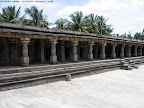
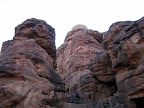
The place gets its name from the color of the rocks in the region. They are similar the color of the dry fruit – Badami and hence the name.


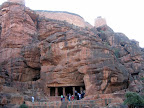
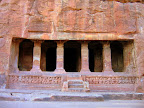
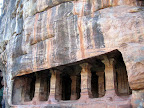
Badami has a number of temples built between the 5th and 8th century, the most famous among them are the cave temples. Due to time constraints and the fatigue of having traveled to Hampi, we decided only to visit these cave temples. There are 4 cave temples (plus one natural cave).

Chalukyas were predominantly followers of Lord Vishnu, however the latter kings were also followers of Lord Shiva. A few also embraced Jainism. This is evident from the 4 cave temples. The first one is dedicated to Lord Shiva, 2nd and 3rd dedicated to Lord Vishnu and the 4th one to Jainism. In the 5th (natural cave) there is a sculpture, though the exact identity of this carving is not know, it is though to resemble Lord Buddha.

The temples have been carved into the hills, except for the deities nothing in the temples is foreign. Everything has been carved into the finely grained horizontally stratified sandstone hills of Badami. Each of these temples are characterized by a pillared “mukha mutapa” (verandha), then a “maha mantapa” and then a small cell – the “garbha gudi” which houses the God.

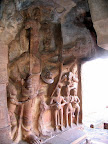
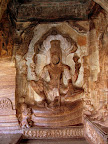
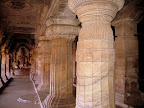
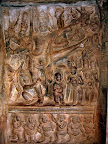
The 3rd cave (from below) dedicated to Lord Vishnu is the oldest among the 4 caves. It is also the most grandest and the biggest of all the 4 caves. The main idol is missing (same is the case with the other Vishnu cave temple) – it is believed to have been destroyed in the 16th century during the muslim invasion. The sculptures and carvings here depict the various incarnations of Lord Vishnu including Bali Chakravarthi, Vijayanarasimha, Ranganatha among others.


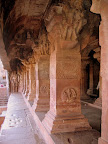
According the inscriptions found, the 3rd cave was completed in 578 AD. The pillar brackets are finely decorated with male and female figures - with fertility being the main theme.


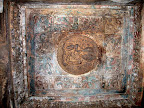
The 6th century paintings on the ceiling of these caves are still visible. The guide told us the main inspiration of these cave temples for the Chalukyas were the Anjantha caves.

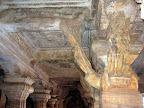
The pillars of this cave temple like all vishnu temples are highly decorated.


The 2nd cave (from below) is the 2nd oldest temple and is also dedicated to Lord Vishnu. It is much smaller than the 3rd cave. However it is very much similar to it.

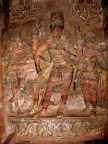
Again this temple consists of various incarnations of Lord Vishnu. The most brilliant carving here is that of Bali Chakravathi (right side picture below). A similar carving is also present in the 3rd cave and it is believed that both these carvings are a replica of carving found in the Durga temple in Aihole.

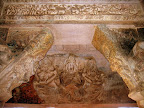
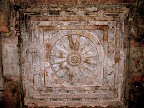
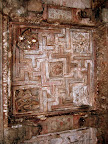
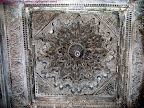
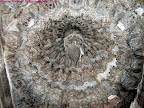
The sculptures on the ceiling in this temple is amazing. Most of the patterns and designs here are replicas of the ones found in the Aihole temples. If you observe the picture below (right side) closely, it can represent a fish wheel (Meena Chakra) or a lotus flower. The 2nd image is that of the scared Swasthik.


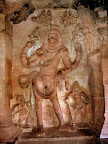
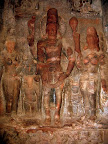
The 1st cave is dedicated to lord Shiva. It is smaller than the 3rd cave but bigger than the 2nd cave. The Shiva Linga is still present but it has been partly damaged. This cave consists of carvings of Shiva, Ganesha, Parvathi and Subramanya. Two very interesting carvings here are that of HariHara (a single carving with one half representing Lord Vishnu and the other half represently Lord Shiva) and that of Shiva Parvathi (again one half of the carving is that of Lord Shiva and the other half that of his wife Goddess Parvathi)

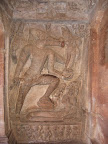
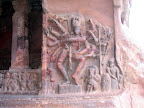
But the most fascinating carving of all is that of Nataraja. This carving depicts Nataraja with 18 hands, and depending on which two hands you consider, you can see a total of 81 dancing positions.


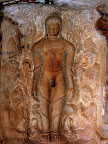
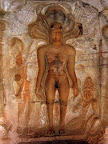
The 4th cave is dedicated to Jainism and consists of various Jain thirthankaras. Though not as big or as elaborate as the other 3 Hindu temples, the sculptures are very unique.

The carving of Lord Gomataeshwara is very similar to the statue found in Shravanabelagola.


Depending on your interests it could take 2-3 hours to view these cave temples. There are other temples in the vicinity, which we skipped. To cover all of them it could take a couple of hours more. The film Guru was also shot in this area.

Close to Badami there is Banashankari Temple and Mahakuta temples. Unless you are deeply religious you may want to skip Banashankari Temple, but the Mahakuta temple complex is worth a visit. Both these places are with in 20km from Badami. Mahakuta was also one of the capitals of the Chalukyas. There are lot of Shiva temples in this complex.


More pictures below:


Monday, January 07, 2008

Aihole

Aihole, it is often called the cradle of “Hindu rock architecture”. This ancient town was once the capital of the early Chalukyan Empire (the capital was latter shifted to Badmi).
Situated on the banks of the holy river Malaprabha (one of the 3 rivers that join at Kudalasangama) this town has more than 125 temples – with no two temples similar to each other. Infact many of the other architecture marvels of Karnataka including the ones at Badami, Pattadakalu, Belur, Halebidu, Somnathpura are based on the temples found in this place.

There is an interesting legend behind the name “Aihole”. Parshurama (the 6th avatara of Lord Rama) after one of his battles, washes his axe in the river Malaprabha, the blood on his axe turns the entire river into red. A lady who happens to be at the river at this instance, is shocked and starts shouting “aiyoo nana hole” (roughly translates to: Oh my river). Hence this place came to be known as “Aihole”. (This was what my guide told me.)

Inscription found there, indicate that during the 7th century this place also used to be a university for stone architecture. Much like modern day universities, this university used to grant “scholarships” to its students. This practice has been documented in one of the 7th century inscriptions found in one of the temples in Aihole. As a pre-requisite to successfully graduate from there the students had to construct a temple – this explains the vast no of temple in this area. This was the early phase of temple architecture in South India. It was the time when rules were yet to be defined. Each temple was an experiment; none of them are even remotely similar to each other.

This place is the foundation stone of the Dravidian and Jaina temple culture. The earliest temples were built here in the 5th century. The “Meguthi” temple here is the oldest dated structural temple in India, it was completed in 634 A.D. The inscriptions at this temple also take of the legendary poet and dramatist Kalidasa.

Aihole is the oldest of the 3 Chalukyan places – Aihole, Badami and Patadakallu. The temples here are spread over a vast region, and only a few are protected. It would take a few days to cover most of this rocky area. I spent less than an hour here and covered only 5 temples.


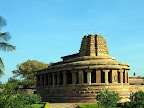
The external architecture of the Indian Parliament was based on the Durga temple. One look at this temple and the first thing that comes to your mind is the Parliament building. This not a temple dedicated to Goddess Durga as the name suggests. The temple is close to the fort and another name for the fort in kannada is durga or durgi and hence it got its name as Durga temple. It is a temple dedicated to Lord Vishnu (early Chalukyans were followers of Lord Vishnu – hence the majority of the temples here are dedicated to Lord Vishnu).

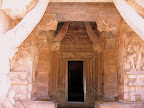
The main tourist place in Aihole is the Durga temple complex. There are around 4 temples with in this fort. And there is another temple (Ambigera Temple Complex) just on the other side of the road.

The sculptures here are very intrinsic and some are very exotic. The sculptures give a deep insight into the social life of the people. Every minute detail from the jewelry to the fashionable dress they wore has been documented in these sculptures. From the sculptures you could guess that short (and even mini) skirts were very popular at that time. Also special attention has been given to the sexual life of the people at that time. Episodes from Ramayana and Mahabharata have also been given great importance in the carvings here.

Unfortunately my camera batteries were drained out and I could take only a few pictures of this wonderful place. There is a KSTDC hotel near by; the food at this place is pretty good. They also have rooms to stay, but the facilities are very basic – there is no power during the day.

Wednesday, October 03, 2007

Srirangapatna and Chamundi Betta

Pictures from my recent visit to Srirangapatna and Chamundi Betta.

Tuesday, October 02, 2007

Rangaswamy Betta

Below are the pictures taken during my recent visit to Ranganathaswamy Temple on the Rangaswamy betta(Hill). The temple was supposedly built during the Ganga Dynasty rule, sometime between 8th century AD to 12th century AD.

The temple is pretty small, and architecturally not really significant. It is located around 70Km from Bangalore on the Bangalore - Gowribidanur road, around 20Km from Doddaballapur. We have to travel a further 6-7Km from the main road. The drive is pretty unpleasant because of the road repair works going on, on the Bangalore Gowribidanur state highway.

After the right turn from the main road, the narrow road is surrounded by lush green fields. The ride gets further bumpy with only traces of tarred roads. As you near the foothill, all you you get is a narrow mud road. Due to the heavy rains overnight, the road was practically washed off and we had to park the vehicle 2Km away from the foothill.

This was my third visit to this place, first one was around 21 years back.

The hill is part of the mountainous range which also includes Nandi betta and Kalavarahalli betta.

There is no clear cut route to the top. Occasionally you will find some directions written on the stones. It will take around 45 mins to reach the top. The lush green fields and the surrounding hills give a wonderful view as you climb up. The view of the Nandi Betta and the Kalavarahalli betta with the hat shaped fog cover over them was a breath taking view.

On the top you will find the Ranganatha Swamy Temple. Recently some some miscreants had dug up the inside of the temple when rumors of some hidden treasure beneath the temple spread. It was latter restored and also a standing version of Ranganatha Swamy idol was installed. The masonry work was extremely bad though. Apart from the temple you will find a well and ruins of some old stone structures. These ruins, which are on the other side of the hill indicate, an old stoned pathway to the temple.

The temple is normally closed during the week days. The temple is maintained by the Muzrai department of Govt of Karnataka. The priest resides in one of the villages at the foothills. People throng the temple on the Saturdays of Sravana massa.

Saturday, August 18, 2007

Somanathapura

From Somnathapura

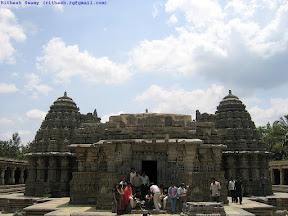
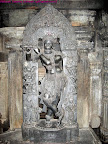
Somanathapura around 40 KM from Mysore houses the temple dedicated to the Lord Keshava. Built by the Hyosalas in the 12th century AD is one of the three main architectural marvels built by them, the other two being Beluru and Halebidu. It was commissioned by Somanatha Dandanayaka, an illustrious general of Hoysala King Narasimha III, and the place is named after him.


This fine example of Hoysala architecture is dedicated to Lord Keshava. It also houses sanctums of Lord Venugopala and Janardhana.

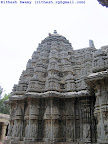
Like most Hoysala monuments Somanathpura temple is star shaped – this design is followed by most Hoysala temples to increase the surface area of the temple.

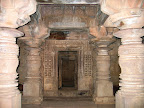
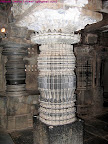
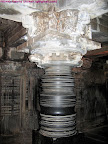
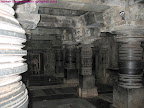
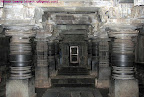
The three shines or the sanctums (Thrikuta design) are identical in design and is built on an elevated platform. The pillars inside the temple are in itself a marvel.


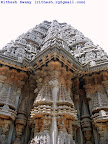
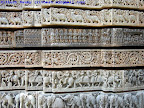
Another feature that this temple shares with the other 2 temples is the bands of intricately carved figures running all around the outer walls. The lowest band contains images of elephants in different postures. The elephant signifies strength and they are supposed to support the temple on them. The next band contains images of horses, again in various postures. Other bands contained various animals and idols and complex patterns, telling us the stories form Ramayana, Mahabharata and other Puranas.


The Father of Hoysala architecture was Amarashilpi Jakanacharya. Jakanacharya was the chief architect of both Belur and Halebidu both of which were built in early 11th century. However the temple at Somanathpura was built only in mid 12th century using most of his ideas.

The temple like the other two temples is carved out of soap stone (technical name - dark grey green chloritic schist). This stone when freshly quarried is soft and easy to work on, however with time they become hard.

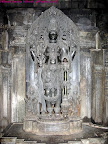
I was surprised to see that pooja was not performed in this temple. Same is the case with the temple at Halebidu. The idol at Halebidu and the temple was damaged by a Muslim ruler Malik Kafur. The original idol of Lord Kesava of Somanathpura is currently in a british museum. Only a replica of the original idol is present here. Also the idols in the 64 cells

around the main temple were either taken away by the british or have been damaged. According to Hindu mythology once the main idol of the temple is damaged, no longer is the pooja offered at the temple. I am not sure if the poojas still take place at the Belu temple. It’s a pity that we have lost such precious souvenir of ancient India. I hope that one day this idol comes back to where it actually belonged.

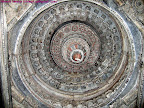
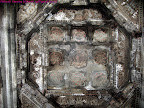
Another wonder to watch in the temple are the ceilings. It’s truly marvelous. I tried my best to capture it on my cam, but being an amateur photographer didn’t help.

One can also observer that the ceilings were painted, I am not sure if these are the original paintings or done latter. My guess is they are the original paintings. However the rain water seeping in through the ceiling has damaged these paintings. I am surprised the ASI hasn’t done anything to stop this. But over all ASI is doing a pretty good job in

maintaining the temple. Absence of the poojas and an entry fee to the temple has certainly help.


I would consider this temple the grandest and the best among the 3 main Hoysala temples. This temple stands testimony to the fact that Karnataka is the cradle of stone architecture in India.

Monday, July 23, 2007

Trek to Kalavara Betta

Its been a few weeks since I had been to this place. I am writing this so that if you happen to read it and plan to go there don’t make the mistake we did.

I had read a lot about this place. This place is so strategically placed that, if you reach the top, you will just be above the cloud level, and you get to see the clouds/fog form the top. I had seen wonderful pictures, and was expecting a similar experience. To my disappointment I didn’t get to see any of this. The blunder we made was, we started climbing late, at around 8:30 in the morning. Also this is was not the ideal time to visit this place. However you could still get a good experience if you start your trek the previous night and reach the top before sunrise.

As we were climbing, we meet a lot of people getting down. Probably a few would have been laughing at us for starting so late. A few of them whom we talked told us about the wonderful sunrise they had seen. Most of them had gone there the previous night itself and spent the night on the top. I am sure it would have been a great experience.

6 of us, packed into one car, left Bangalore at 7:00AM and reached there around 8:30 (we could have reached there much earlier if Mr Nag had handed the wheel to someone else). At around 8:40 we started climbing. The sun was kind on us. The first 20-25 minutes everyone where just trying to race each other. After that we climbed for 5 minutes and rested for 10 minutes. I will take around 1:45 to 2 hours to reach to the top.

The fort

As we reach the top we cross an old fort. One of my uncles (grandmother’s younger brother) latter told me that the construction of this fort was started by Hyder Ali and completed by Tipu Sultan. My uncle during his childhood days, it seams used to go grazing cattle all the way up to this fort when they had holidays. The fort is pretty impressive and strategically placed. The stone walls are quite impressive considering the height at which they are built.

The temple

At the top you will also find an old temple. It’s the temple of Lord Ganesh. Its very simple, with just a single room and the Lord placed at one end. You will find a Nandi opposite the temple. Interesting because, you generally find a Nandi in front of a Shiva Temple.

The scenery and the winds

At the top the winds are extremely powerful. If you jump, probably you could be pushed off a bit. On the southern side you get a wonderful view of the Nandi hills and the steep “Tipu drop”. On the eastern side you get to see the whole of Chikballapur town and National Highway 7. To the northern and western side we can see a lot of other hills and forests between them.

Mistake you shouldn’t make if you plan to visit this place

The best time of the year to go here would in the winter season between Nov to Feb. You will get a wonderful view of the fog/clouds from the top. It would be ideal to climb at night. A full moon night would be perfect but then expect a huge crowd – which actually is better considering security. Start your climb around 12:00 AM. You will need a lot of water and a few packets of snacks will certainly help you. You won’t find any of them once you start your climb. Carry lots of lighter/match sticks and collect a few dry wood as you trek. However I doubt how successful you will be in starting a bonfire considering the heavy winds. It could get a bit cold on the top, so you may want to carry a jersey.

Beer bottles

You will be appalled to see the number of empty beer bottles and plastics thrown around. Do take care not to add to this. It’s a wonderful place.

Other Details

Location:

Kalavara Betta, Chikballapur

How to get there:

Take NH7 from Bangalore and proceed towards Chikaballapur(58 Km from Hebbal). Once you reach the town, at the Sir M Vishveshvaraiah Cricle take a left. Proceed in this narrow lane leading you outside the town to reach the Omkareshwara Ashrama – around 6-7 KM from the town. You will have walk from this point on.

Best time to visit:

Nov to Feb